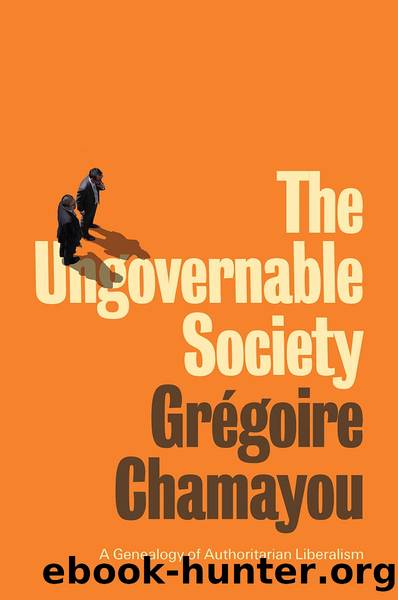
The Ungovernable Society by Grégoire Chamayou
Author:Grégoire Chamayou [Chamayou, Grégoire]
Language: eng
Format: epub
Published: 2021-05-17T00:00:00+00:00
Notes
1. André Gorz, Misère du présent, richesse du possible (Paris: Galilée, 1997), p. 29.
2. Quoted in Arion N. Pattakos, âGrowth in Activist Groups: How Can Business Cope?â, Long Range Planning, vol. 22, no. 3, June 1989, pp. 98â104 (p. 98).
3. S. Prakash Sethi, âCorporate Political Activismâ, California Management Review, Spring 1982, vol. 24, no. 3, pp. 32â42 (p. 32).
4. W. Howard Chase, Issue Management: Origins of the Future (Stamford, CA: Issue Action Publication, 1984), p. 13.
5. Barrie L. Jones and W. Howard Chase, âManaging Public Policy Issuesâ, Public Relations Review, vol. 5, no. 2, 1979, pp. 3â23 (p. 7).
6. Quoted in Jones and Chase, âManaging Public Policy Issuesâ, p. 9.
7. The authors silently took this from the management theorist S. Prakash Sethiâs Business and Society: Dimensions of Conflict and Cooperation (Lexington, MA: Lexington Books, 1987), p. 344.
8. S. Prakash Sethi, Multinational Corporations and the Impact of Public Advocacy on Corporate Strategy; Nestlé and the Infant Formula Controversy (New York: Kluwer Academic Publishers, 1994), p. 373.
9. Richard E. Crable and Steven L. Vibbert, âManaging Issues and Influencing Public Policyâ, Public Relations Review, vol. 11, no. 2, Summer 1985, pp. 3â16 (p. 10).
10. Ibid.
11. Sanders, âIssues Managementâ, p. 26.
12. Sethi, Multinational Corporations, p. 334.
13. S. Prakash Sethi, âA Strategic Framework for Dealing with the Schism between Business and Academeâ, in S. Prakash Sethi and Cecilia M. Falbe (eds.), Business and Society: Dimensions of Conflict and Cooperation (Lexington, MA: Lexington Books, 1987), pp. 331â52 (p. 333). More generally, âAnother key element in the overall strategy is the formation of alliances with [â¦] government, academic, religious and the media. All too often it happens that industry will look to one of those disciplines for help or advice in a crisis without first having laid the foundation for a permanent relationshipâ (Charles Vrtis, âCorporate Responsibility in Developing Countries: Focus on the Nestlé Infant Formula Caseâ, PhD dissertation, Ball State University, Muncie, 1981, p. 33). If these alliances are set up well in advance, in times of calm, they will be solid and will protect the business in stormy times. That way, the firm will build up a stock of strategic resources that will, the day it faces a crisis, allow it to have a bit of âslackâ (Sethi, âA Strategic Frameworkâ, p. 375). So the aim is to accumulate credibility, trust and reputation as a preventive measure â a whole safety net of resources that will deaden any shocks and âresist demand for changeâ (Sethi, âA Strategic Frameworkâ, p. 376). In the case of the Nestlé boycott, the polemics over the substitute for motherâs milk had started in the medical world, and this had been the main milieu that needed to be won back. Pagan had set up a strategy of âmanipulation through assistanceâ, which consisted in handing out money to researchers to gain their goodwill. See Jean-Claude Buffle, Dossier N comme Nestlé (Paris: Alain Moreau, 1986), p. 30.
14. See Naomi Oreskes and Erik M. Conway, Merchants of Doubt: How a Handful of Scientists Obscured the Truth on Issues from Tobacco Smoke to Global Warming (New York: Bloomsbury Press, 2010).
Download
This site does not store any files on its server. We only index and link to content provided by other sites. Please contact the content providers to delete copyright contents if any and email us, we'll remove relevant links or contents immediately.
| Anthropology | Archaeology |
| Philosophy | Politics & Government |
| Social Sciences | Sociology |
| Women's Studies |
Cecilia; Or, Memoirs of an Heiress — Volume 1 by Fanny Burney(32558)
The Great Music City by Andrea Baker(32019)
Cecilia; Or, Memoirs of an Heiress — Volume 2 by Fanny Burney(31956)
Cecilia; Or, Memoirs of an Heiress — Volume 3 by Fanny Burney(31942)
We're Going to Need More Wine by Gabrielle Union(19046)
All the Missing Girls by Megan Miranda(16027)
Pimp by Iceberg Slim(14507)
For the Love of Europe by Rick Steves(14121)
Bombshells: Glamour Girls of a Lifetime by Sullivan Steve(14075)
Talking to Strangers by Malcolm Gladwell(13370)
Norse Mythology by Gaiman Neil(13365)
Fifty Shades Freed by E L James(13241)
Mindhunter: Inside the FBI's Elite Serial Crime Unit by John E. Douglas & Mark Olshaker(9343)
Crazy Rich Asians by Kevin Kwan(9292)
The Lost Art of Listening by Michael P. Nichols(7506)
Enlightenment Now: The Case for Reason, Science, Humanism, and Progress by Steven Pinker(7313)
The Four Agreements by Don Miguel Ruiz(6765)
Bad Blood by John Carreyrou(6621)
Weapons of Math Destruction by Cathy O'Neil(6280)
